Most small business websites have decent content buried under weak on-page SEO — a vague title tag here, a missing heading structure there, and Google never quite understands what the page is about. On-page SEO is the part of SEO you have complete control over: no algorithm mystery, just a checklist of things to get right on every single page. A Wollongong dentist and a Perth landscaper both need to run through the same fundamentals; only the words change.
1. Give every page one clear purpose
Before you touch a heading or a keyword, decide what one page is "about". A single service page trying to rank for teeth whitening, root canals and general check-ups all at once will struggle to rank well for any of them. Split it: one page, one topic, written for the person who's already decided they need that specific thing.
2. Write a strong, unique title tag
The title tag is the blue clickable headline in Google's search results, and it's one of the strongest on-page signals you control. For each page:
- Keep it under roughly 60 characters so it doesn't get cut off.
- Put the focus keyword near the front where practical.
- Include your suburb, city or service area for local pages.
- Never duplicate the same title across two different pages.
"Emergency Plumber Geelong | 24/7 Callouts" tells both Google and the searcher exactly what they'll get. "Home" or "Services" tells them nothing.
3. Write a meta description that earns the click
The meta description doesn't directly boost rankings, but it strongly influences whether someone clicks your result over a competitor's. Aim for 140–160 characters, lead with the benefit, and include a soft call to action. Think of it as your one-line pitch in a crowded search results page.
4. Use one H1, then a logical heading structure
Every page needs exactly one H1 — usually matching or closely echoing the page's main topic. From there, use H2s for major sections and H3s for sub-points within them, in order, without skipping levels. This isn't just tidy formatting; it helps Google (and screen readers) understand how your content is organised.
5. Write content that actually helps the reader
Thin, generic content is the single biggest reason otherwise well-built pages don't rank. Google's own Search Central guidance consistently points toward rewarding content that genuinely helps people, not content stuffed with keywords. For each page, ask:
- Does this answer the questions a real customer would have?
- Is there enough substance here, or is it padding?
- Would a Dubbo customer researching this service actually learn something?
6. Use your focus keyword naturally, not repeatedly
Include your target phrase in the H1, in the first paragraph, and a couple of times naturally through the body — never forced, never in every sentence. If a sentence reads awkwardly because you've crammed a keyword into it, rewrite it. Modern search engines read for meaning, not just exact-match repetition.
7. Optimise your images
Images carry SEO weight too, and they're commonly ignored. For every image:
- Use a descriptive file name (
hills-hoist-installation-adelaide.jpg, notIMG_4021.jpg). - Write meaningful alt text that describes the image for someone who can't see it.
- Compress files so they don't slow the page down.
Our image SEO guide covers this in full detail if you want to get it exactly right.
8. Link internally to related pages
Internal links help visitors find related information and help Google understand which pages on your site are most important. Link from your blog posts to relevant service pages, and between service pages that naturally relate to each other. A roofing company's storm damage page, for instance, should link to its insurance claims page and vice versa. See our internal linking guide for a deeper strategy.
9. Check your URL structure
Short, readable URLs beat long strings of numbers or parameters. /services/hot-water-repairs is clear to both humans and search engines; /page?id=3847 tells nobody anything. Set this up correctly from the start — changing URLs later requires careful redirects to avoid losing rankings.
10. Make sure the page is mobile-friendly
Most searches happen on a phone, and Google evaluates the mobile version of your site by default. Check that text is readable without zooming, buttons are easy to tap, and nothing overlaps or requires horizontal scrolling.
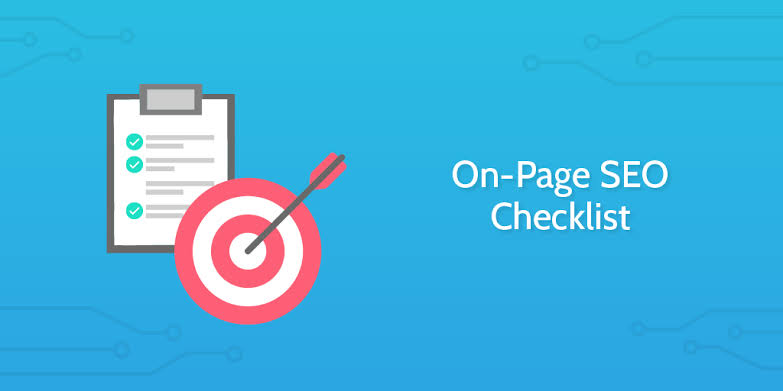
On-page SEO checklist at a glance
| Element | What to check | Common mistake |
|---|---|---|
| Title tag | Unique, under ~60 characters, keyword near front | Same title copied across pages |
| Meta description | 140–160 characters, benefit-led | Left blank, Google writes its own |
| Headings | One H1, logical H2/H3 structure | Multiple H1s or skipped levels |
| Content | Genuinely useful, answers real questions | Thin, generic, duplicated across pages |
| Images | Descriptive file names and alt text | Alt text left blank or keyword-stuffed |
| Internal links | Links to and from related pages | Orphan pages with no internal links |
| URL | Short, readable, keyword-relevant | Long strings of numbers or parameters |
| Mobile | Readable and tappable on a phone | Text too small, buttons too close together |
Key Takeaways
- One page should target one clear topic — don't make it compete with itself.
- Titles and meta descriptions are your first impression in search results; make them count.
- Content quality beats keyword repetition every time.
- Images, internal links and URLs are easy wins that are often skipped entirely.
- Run this checklist on your most important pages first, then work outward.
Frequently Asked Questions
What's the difference between on-page and technical SEO?
On-page SEO covers the content and structure of an individual page — titles, headings, copy, images. Technical SEO covers the underlying site infrastructure — speed, crawlability, security and site architecture. Both matter, and our technical SEO checklist covers the other half.
How many keywords should I target on one page?
Focus on one primary keyword and a small handful of closely related terms your customers would naturally use. Trying to target many unrelated keywords on a single page dilutes its focus and usually hurts rather than helps.
Do I need to update old pages for on-page SEO?
Yes, ideally on a regular basis. Search behaviour and competition change over time, so revisiting your best-performing or most important pages every six to twelve months to refresh content and check the basics is good practice.
How long should a page be for good on-page SEO?
There's no magic word count. A page should be as long as it needs to be to genuinely answer the topic — a simple contact page needs little text, while a detailed service explanation may need several hundred words to cover common questions properly.
Does on-page SEO help with Google Ads too?
Indirectly, yes. A well-structured, fast, relevant landing page tends to score better on Google's Quality Score for ads, which can lower your cost per click. See our SEO vs Google Ads guide for how the two work together.
Should every page have a call to action?
Yes. Even informational content should point the reader toward a next step — whether that's contacting you, reading a related article, or viewing a service page. Our website copywriting that converts guide covers how to write these well.
Can I check my on-page SEO for free?
Yes. Google Search Console shows you how your pages are performing in search, and a manual page-by-page review against this checklist costs nothing but time.
What should I fix first if I have a lot of pages to improve?
Start with the pages that matter most commercially — your key service pages and highest-traffic content — rather than trying to fix everything at once.
Get your pages working harder
On-page SEO is detailed, repetitive work, but it's entirely within your control. If you'd rather have it done properly across your whole site, have a chat with Pixel and Pine and we'll run the full checklist for you.