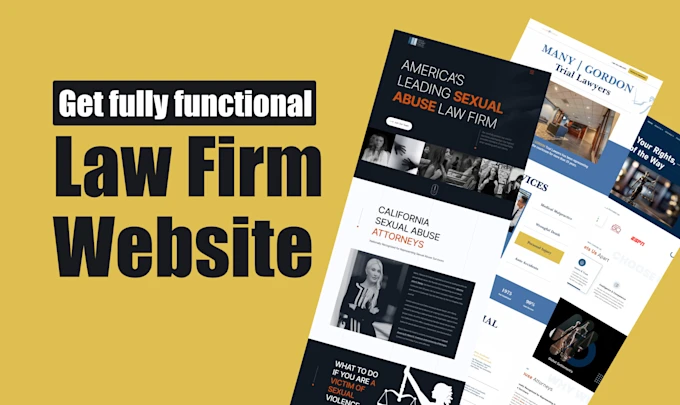
Someone landing on a law firm's website is rarely in a good mood. They've just been served papers, they're mid-divorce, or a business deal has gone sideways — and they're trying to work out, in about fifteen seconds, whether this firm understands their problem and whether they can afford to ask. Law firm website design has to calm someone down while proving competence, without a wasted word. Get that balance wrong and the visitor closes the tab and rings a competitor instead.
What legal clients actually want before they call
People searching for a lawyer aren't browsing for fun — they're trying to solve a problem, usually one they'd rather not have. Before they'll pick up the phone or send an enquiry, they need answers to a short, urgent list of questions:
- Do you actually do this? A stressed parent looking for a family lawyer doesn't want to guess from a generic "commercial and civil law" page. They want to see "family law" and "parenting arrangements" in plain sight.
- Will I be judged? Especially in family and criminal law, visitors are often embarrassed or anxious. A warm, plain-spoken tone matters enormously here.
- What will this cost me? Even a rough idea of how fees work reduces fear more than almost anything else on the page.
- Can I ask privately, without calling? A phone call feels exposing when you're upset or at work. A quiet, confidential way to make first contact often gets the enquiry sent.
- Who will I actually be dealing with? A firm name isn't reassuring on its own — people want to see the person's face before they trust them with something personal.
A firm that answers these clearly, in plain English, wins the enquiry. A firm that hides behind jargon and a bare "Contact Us" button loses it to whoever explains things better.
Must-have features for a law firm website
| Feature | Why it matters |
|---|---|
| Plain-English practice area pages | Lets a stressed visitor see instantly, without translating legalese, that you handle their exact issue |
| Confidential enquiry form | Gives anxious visitors a private way to make contact without the exposure of a phone call |
| Solicitor bios with photos and qualifications | Clients want to know who they'll actually be dealing with before they trust that person |
| Clear fee guidance | Reduces the fear of an unknown bill, which is often the single biggest barrier to enquiring |
| Professional body membership and experience | Signals legitimacy from a body like the Law Society or Law Institute in your state |
| Urgent matter guidance | Tells someone facing a court date tomorrow exactly how to reach you fast |
| De-identified or consented testimonials | Builds trust without breaching the confidentiality your clients rely on |
| Mobile-first layout | Most people searching for a lawyer in a moment of stress are doing it on a phone |
If you're building out the wider site and want the non-negotiables that apply to any small business, our small business website checklist is a solid companion to run alongside this list.
Practice area pages that don't read like a contract
This is where most law firm websites lose people. A page titled "Family Law" that opens with paragraphs about the Family Law Act doesn't tell a stressed parent anything useful. Consider a family law firm in Newcastle: a visitor searching late at night after a difficult conversation with their ex-partner wants to know, quickly, whether this firm handles parenting arrangements, property settlements, or urgent intervention orders — not legislation.
Practice area pages work best when they:
- Name the actual situation, not just the legal category. "Help with parenting arrangements after separation" reads faster than "Family Law Matters."
- Explain what happens next in plain terms. A short outline of what a first meeting looks like removes a huge amount of anxiety.
- Avoid stacking every service into one long list. Break practice areas into their own pages — a visitor scanning quickly should never have to hunt.
- Use real, everyday language. Save "pursuant to" and "the party of the first part" for the documents, not the website.
- End with a clear, low-pressure next step. A confidential enquiry link works better here than a hard sell.
Firms that get this right are doing the work described in why your business needs a professional website — using the site to build trust before a single conversation happens.
Solicitor bios: let people see who they're trusting
Legal advice is deeply personal, and clients want to know the person behind it before they ever step into a meeting room. A strong bio page includes a real photo (not a generic stock image), qualifications and admission details, years practising and areas of focus, any relevant accreditations, and a short, human note about how they work with clients.
For a family law firm in Newcastle, a bio mentioning specific experience in parenting matters or property settlements earns more trust than any homepage tagline. People aren't hiring a firm in the abstract — they're hiring a specific person to sit across from them during a hard conversation.
Fees: say something, even without exact numbers
Silence on fees is one of the fastest ways to lose an enquiry. Most people have no idea what a family law matter, a criminal defence, or a commercial dispute typically costs, and that uncertainty is genuinely frightening. You don't need a full price list — just enough to remove the worst of the unknown:
- Stating whether the first consultation is free, fixed-fee, or charged at an hourly rate
- Explaining, in general terms, how billing works (hourly, fixed-fee for certain matters, or no-win-no-fee for relevant litigation)
- Being upfront that costs vary by complexity, while still giving a starting point
A firm that says something honest about cost will almost always beat a competitor's page that says nothing at all.
Confidential enquiries and urgent matters
Not every enquiry is equal, and your website should make that obvious at a glance. A general question about updating a will is a different situation to someone who has a court appearance tomorrow morning.
- Make the enquiry form genuinely private. State clearly that details submitted are confidential and only seen by the relevant solicitor.
- Separate urgent matters from general enquiries. A clearly marked "need urgent legal help" path, with a direct phone number, reassures someone in crisis they won't wait days for a reply.
- Never make a distressed visitor hunt for contact details. Both options should be visible without scrolling, on every page.
Local SEO for law firms in Australia
Legal searches are almost always practice area plus location: "family lawyer Newcastle," "criminal defence solicitor Newcastle," "conveyancing lawyer Newcastle." Ranking for these combinations matters more than a generic term like "lawyer."
- Claim and complete your Google Business Profile, with accurate practice areas, opening hours, and a link straight to your confidential enquiry page.
- Weave suburb and practice area language naturally into your copy, so phrasing like "family lawyer Newcastle" appears in headings and page titles, not stuffed in.
- Build a dedicated location page for each office if your firm operates from more than one.
- Encourage reviews carefully. Reviews are a major trust factor in law, but confidentiality is sensitive — many firms ask satisfied clients for a general, de-identified review rather than one naming the matter.
Trust signals that matter in law
Choosing a lawyer is a high-stakes decision made with limited information, so the signals on your site carry real weight: professional body membership, years of relevant experience, clearly stated qualifications, plain-English content, and honest fee information. Genuine testimonials help too, but only when de-identified or given with explicit consent — never invented. Stack these consistently and a hesitant visitor moves from "I hope they're any good" to "I trust this firm enough to enquire."
Common mistakes law firms make with their websites
Most underperforming law firm sites share a familiar set of problems:
- Dense legalese that reads like a court filing instead of a conversation with a worried client
- No fee guidance whatsoever, which creates fear and pushes visitors to a competitor who explains things more clearly
- No confidential or private enquiry option, leaving a phone call as the only way to make first contact
- Stock photography of gavels and generic "lawyer in a suit" imagery instead of the real team clients will actually meet
- One long, undivided list of practice areas with no explanation, forcing visitors to guess whether their specific issue is covered
- Ignoring mobile users, despite many legal searches happening from a phone in a stressful moment
If any of these sound familiar, our guide on how to choose a web design agency is worth reading before you commit to a rebuild.
Key Takeaways
- Legal visitors are usually stressed, not casually browsing — plain English and reassurance matter more than polish.
- Practice area pages should name the real-life situation, not just the legal category.
- Some indication of fees, even general, beats silence every time.
- A confidential enquiry option and a clear urgent-matter path give visitors control over how they make first contact.
- Solicitor bios with real photos and qualifications build trust faster than firm-wide branding alone.
- Local SEO around practice area and suburb searches, backed by a strong Google Business Profile, drives steady, ready-to-act enquiries.
Frequently Asked Questions
Do I need to publish exact prices on my law firm website?
Not necessarily, but you should say something. Stating whether the first consultation is fixed-fee or free removes much of the fear that keeps hesitant visitors from enquiring at all.
How private is a confidential enquiry form, really?
It's only as private as you make clear it is. State explicitly on the form that submissions go directly to the relevant solicitor and aren't shared, and treat that promise as non-negotiable in how the form is actually handled.
Should every solicitor have their own bio page?
Yes. Clients are hiring a person, not just a firm name, so a proper bio with a real photo, qualifications and areas of focus helps a stressed visitor feel they know who they're about to speak with.
Can I use client testimonials on my website?
Only with genuine consent, and ideally de-identified given how sensitive legal matters can be. Never invent a testimonial — in an industry built on trust, a discovered fabrication does lasting damage.
What's the biggest SEO opportunity for a small law firm?
Local searches that combine practice area and suburb, such as "family lawyer Newcastle." A complete, well-reviewed Google Business Profile paired with clearly written practice area pages usually delivers more enquiries than broad, generic terms ever will.
Does plain English make a firm look less professional?
No — it tends to do the opposite. Clients read jargon-free content as a sign a firm genuinely wants to be understood, which builds more trust than language designed to sound impressive.
Ready for a website that earns trust from the first click
Your clients are trusting you with something that matters to them, often at a difficult time — your website should reflect that seriousness, not undercut it with jargon. If you'd like a law firm website design that's clear, reassuring and easy for a stressed visitor to act on, have a chat with Pixel and Pine.